Cape Town’s water supply has shown a slight improvement following rainfall in the past week, but overall dam levels remain under pressure after a steady decline through early April.
In the weeks leading up to 24 April 2026, the city’s combined dam storage had been gradually decreasing. Readings from early April placed levels at around 45.9%, dropping to approximately 44.8% by 13 April and further down to about 44.5% by mid-month. This downward trend reflected ongoing consumption and a lack of significant inflows before the recent weather system.
A cold front moved across the Western Cape during the week of 20–24 April, bringing widespread rainfall and raising hopes of meaningful recovery in dam levels. In some areas, rainfall totals were substantial enough to generate runoff into catchment areas feeding the region’s major dams.
The latest available data suggests that the rain has had a positive, albeit limited, impact. Combined dam levels increased slightly from roughly 44.2% before the rainfall to around 44.5% afterward – an uptick of about 0.3 percentage points. While small, this marks a break in the declining trend observed earlier in the month.
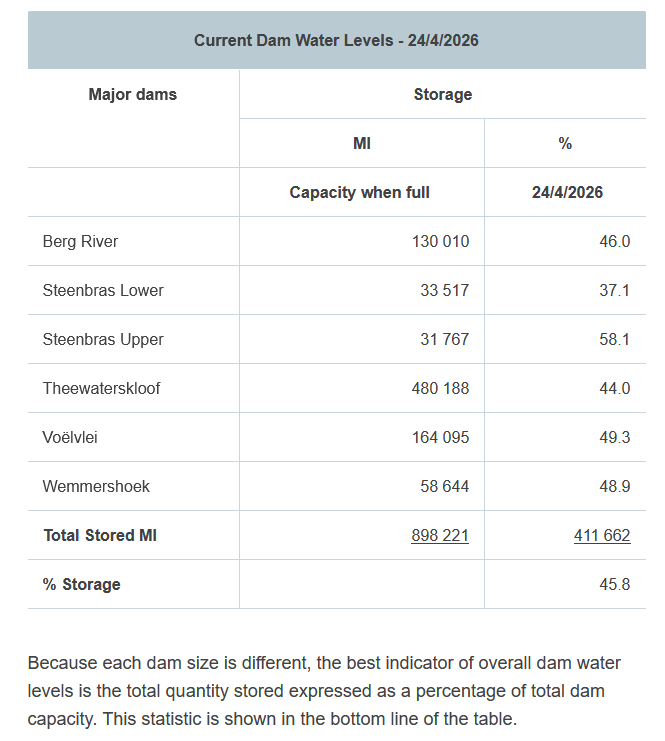
The modest increase indicates that inflows have begun, but the system has yet to see the full benefits of sustained runoff. Large dams, which play a critical role in the region’s water supply, typically respond more slowly and require prolonged rainfall to show significant gains.
Despite the recent improvement, the overall water outlook remains cautious. Current levels are still relatively low for this time of year, and the gains from a single week of rain are not enough to reverse the broader downward trajectory.
In conclusion, while the recent rains have provided some welcome short-term relief and halted the immediate decline in dam levels, they have not significantly improved Cape Town’s water reserves. Continued rainfall in the coming weeks will be essential to meaningfully boost storage levels and secure the city’s water supply.