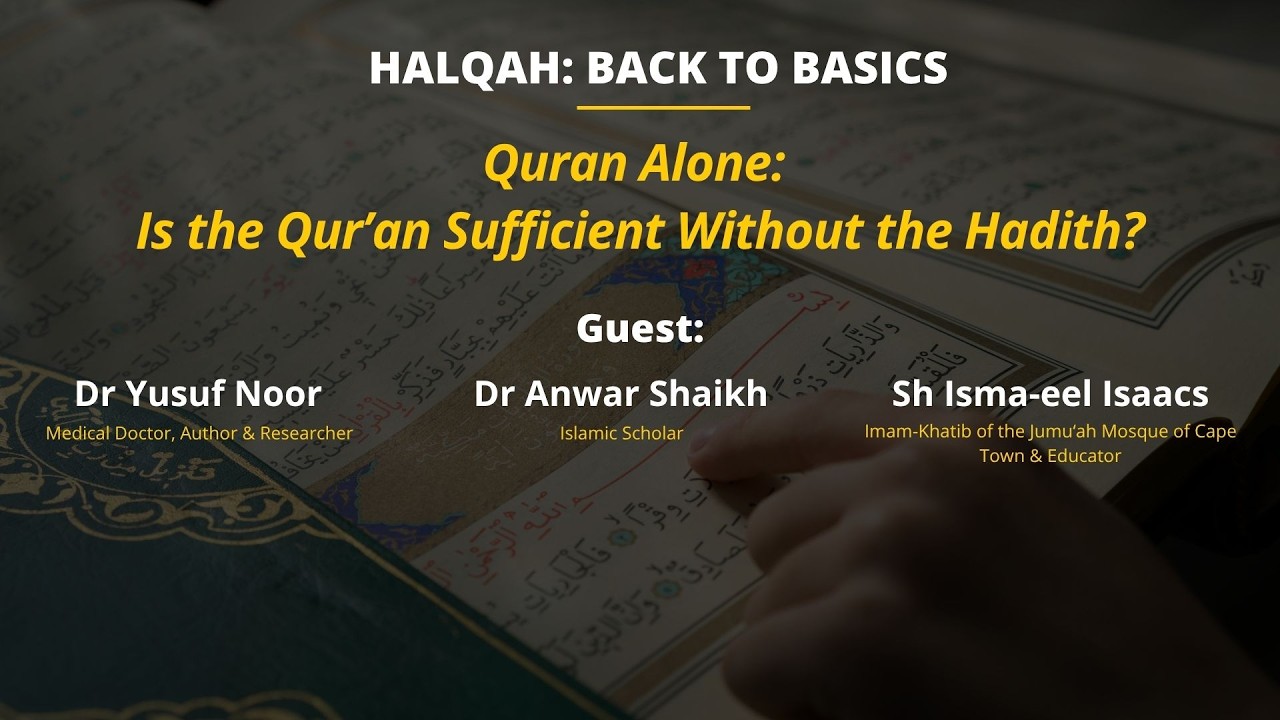
Can Muslims follow the Qur’an without Hadith? Is the Qur’an alone sufficient as a source of religious guidance, or does the Qur’an itself instruct believers to follow the teachings and example of Prophet Muhammad ﷺ?
On this special episode of Halqa – Back to the Basics, presenter Zainab Bean brings together three guests with differing perspectives for an in-depth discussion on the authority, authenticity and preservation of Hadith in Islam.
Joining the discussion are:
Dr Yusuf Noor – Medical doctor, author and researcher, with a particular interest in the relationship between faith, science and the Qur’an. Author of Document X: Direct Evidence of God’s Existence.
Dr Anwar Shaik – Islamic studies and Arabic background, with a Science degree from UCT and a Doctorate in Education from the University of Liverpool. He hosts a podcast exploring the Qur’an as a standard for guiding and evaluating religious practice.
Sheikh Isma-eel Isaacs – Imam-Khatib of the Jumu‘ah Mosque of Cape Town, practising attorney, and Arabic and Islamic studies educator. He holds an MA in Arabic from UWC and is pursuing a PhD at UWC.
In this discussion, we explore:
Can Islam be practised through the Qur’an alone?
What does the Qur’an say about obeying and following the Messenger ﷺ?
Is Hadith essential to understanding and performing Salah?
How were Hadith preserved, authenticated and classified?
What is the difference between Sahih, Hasan and Da’eef narrations?
How should Muslims approach Hadith that appear to contradict the Qur’an?
Why is Qur’an-only thinking gaining popularity?
How can Muslims engage with differing perspectives while maintaining respect and seeking knowledge?
The discussion also examines Qur’anic references including Surah An-Nisa (4:59 and 4:80), Surah Al-Hashr (59:7), Surah Al-Ahzab (33:21) and Surah An-Nahl (16:44).
This is an opportunity to engage with an important and sometimes contentious question through evidence, scholarship and respectful dialogue.