
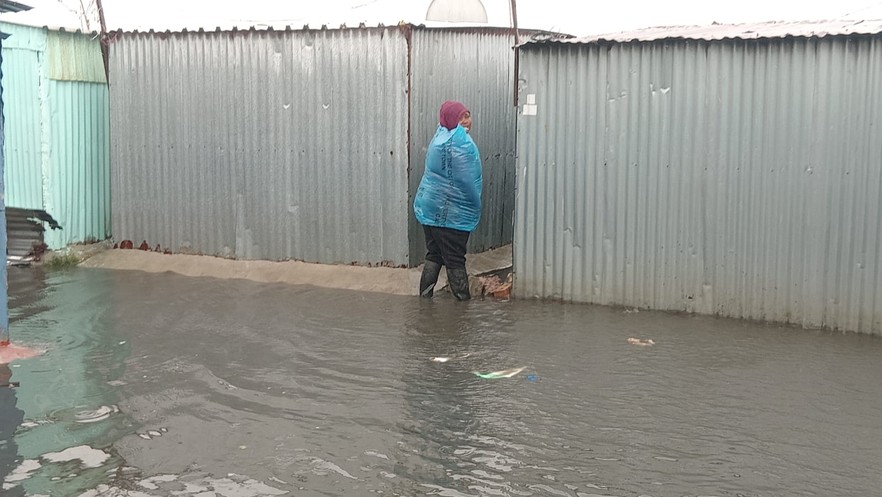
More than 41 000 people have been affected by the severe storm that has lashed Cape Town and parts of the Western Cape over recent days, causing widespread flooding, infrastructure damage and major disruptions on key transport routes.
The City of Cape Town’s Disaster Risk Management Centre says flooding has been reported in at least 26 informal settlements across the metro as heavy rainfall and gale-force winds continue to impact vulnerable communities.
Disaster Risk Management Centre spokesperson Charlotte Powell says assessments conducted so far indicate that 10 703 structures have been damaged or affected by the weather.
“Assessments to date show that 10 703 structures have sustained weather-related impacts, affecting approximately 41 635 persons,” Powell said.
The worst-hit areas include several low-lying informal settlements where homes have been flooded and residents displaced.
Powell says the City is working closely with humanitarian organisations to assist affected residents.
“We are working closely with our humanitarian relief partners who have already started assisting with meals and blankets in some of the affected areas – this relief will be extended as assessments are concluded,” she said.
The findings from ongoing assessments are also being submitted to the South African Social Security Agency (SASSA) and the National Department of Human Settlements to facilitate further humanitarian support.
Beyond the humanitarian impact, the storm has also caused widespread damage to infrastructure across the city.
“In terms of infrastructure impacts, multiple roads have been flooded across the metropole, with some incidents impacting surrounding properties,” Powell said.
City teams from the Roads and Infrastructure Management Department have been deployed to affected areas including Phola Park, Fisantekraal, Bonteheuwel, Parow, Bellville and Hout Bay.
Officials are also continuing efforts to restore electricity to affected communities after strong winds damaged power infrastructure and uprooted trees across the metro.
“Teams are also continuing efforts to restore electricity outages in affected areas and clearing trees that have been uprooted or lost branches due to the strong winds,” Powell added.
While authorities say weather conditions are expected to begin easing later on Tuesday, emergency services remain on high alert.
Residents have been urged to report service-related issues through the City’s call centre, website or mobile application, while emergencies posing immediate threats to life or property should be reported directly to the Public Emergency Communication Centre.
Meanwhile, the Western Cape Mobility Department says several major roads and mountain passes remain severely affected by flooding and storm damage, particularly along the N1 corridor between Touws River and Worcester.
Authorities have confirmed the closure of several critical routes, including Du Toitskloof Pass, the N1 Huguenot Tunnel, Bainskloof Pass and sections of the N1 near Du Kloof Lodge, Sandhills and De Wet Kelder.
Both directions of traffic have been affected in some areas due to flooding and debris.
Motorists have also been warned about dangerous conditions on several mountain passes.
Nuwekloof Pass remains accessible only from the Tulbagh side and cannot currently be reached from Ceres, while Mitchells Pass between Ceres and Wolseley is operating under stop-and-go conditions.
Theronsberg Pass also remains under close monitoring due to high-risk conditions and limited cellular coverage in the area.
Authorities are urging motorists to avoid unnecessary travel and to remain updated on road closures and weather alerts as clean-up operations continue across the province.