
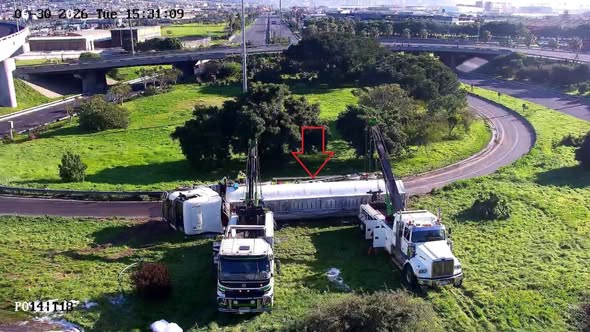
Motorists travelling through Cape Town faced major delays on Tuesday after a jet fuel tanker overturned at the Koeberg Interchange, prompting extensive road closures and a large-scale hazardous materials response.
Emergency services remain on scene as crews work to safely recover the tanker, while authorities have urged commuters to avoid the area throughout the afternoon.
Cape Town Traffic Services spokesperson Kevin Jacobs said recovery operations are currently underway and appealed to motorists leaving the Cape Town CBD to make use of alternative routes.
“We appeal to motorists to seek alternative routes Tuesday afternoon as they head out of the CBD, including Nelson Mandela Boulevard and Philip Kgosana Drive,” Jacobs said.
He also encouraged road users to make use of GPS navigation applications to identify the safest alternative routes while emergency operations continue.
Multiple Roads Closed
Authorities have implemented several road closures around the interchange to create a secure working area for recovery teams and emergency personnel.
The affected roads include:
- FW de Klerk Boulevard outbound at Marine Drive.
- Marine Drive onto FW de Klerk Boulevard outbound.
- M5 Berkley Road northbound.
- Koeberg Road northbound at Cannon Road and Royal Road.
- Koeberg Road northbound at Section Street.
- Both ramps from the N7 onto the N1.
Traffic officials warned that congestion is expected to spread onto surrounding arterial routes as motorists divert around the closures.
Hazardous Materials Protocols Activated
Disaster Risk Management’s Jermaine Carelse said specialised incident management procedures have been activated because the tanker was transporting aviation fuel, which presents significant fire and environmental hazards.
Jet fuel has a relatively high flash point compared to petrol, making it less volatile under normal conditions, but it remains highly combustible when exposed to heat, sparks or open flames. For that reason, emergency responders establish extensive safety perimeters, eliminate potential ignition sources and carefully monitor for leaks before recovery operations begin.
Specialist hazardous materials (HazMat) teams typically assess the structural stability of the vehicle, contain any fuel spills to prevent contamination of stormwater systems, and ensure the product can be safely transferred or the vehicle recovered without creating further risk.
Authorities have not indicated whether any fuel leaked from the tanker, nor have they reported any injuries linked to the incident.
Recovery Likely to Take Several Hours
Recovering an overturned fuel tanker is generally a complex operation that can take several hours. Before the vehicle can be removed, emergency crews must ensure it is stable, assess whether the remaining fuel needs to be offloaded into another tanker, and verify that the scene is safe for heavy-duty recovery vehicles to operate.
Only once the area has been declared safe can the damaged vehicle be uprighted and removed, after which engineers inspect the roadway for any damage before traffic is allowed to resume.
Motorists Urged to Avoid the Area
Traffic officials have urged commuters to delay non-essential travel through the Koeberg Interchange where possible and to use alternative routes, including Nelson Mandela Boulevard and Philip Kgosana Drive.
With the afternoon peak-hour traffic expected to intensify, authorities have warned that significant delays are likely to continue until the recovery operation has been completed and all affected roads have been reopened.
Emergency services remain on scene and will provide further updates as recovery efforts progress.