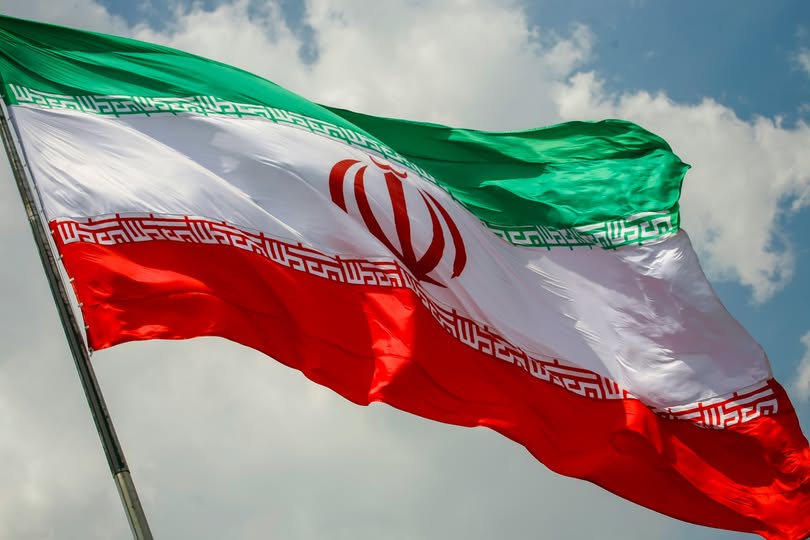
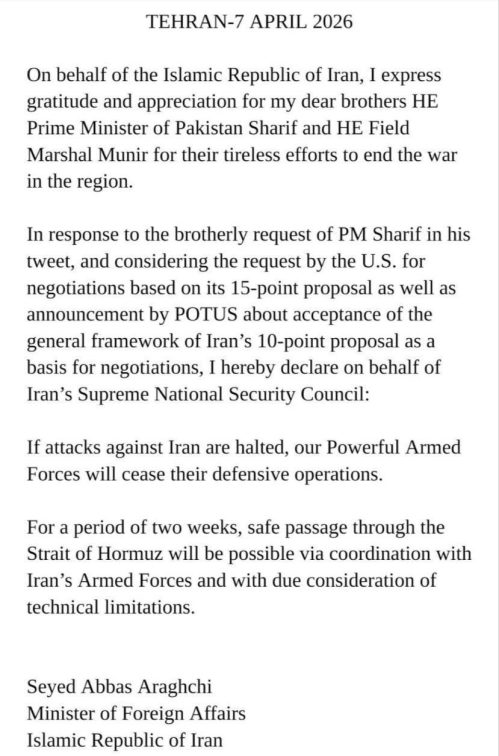
After 40 days of US-Israeli aggression, Iran and the United States have agreed to a temporary two-week ceasefire, with negotiations scheduled to begin in Islamabad on Friday, April 10. The announcement comes amid continued hostilities and deep mistrust between the two sides.
Iran’s Secretariat of the Supreme National Security Council said the ceasefire follows what it described as the country achieving “almost all of the war’s objectives.” Iranian officials claim that sustained military operations, including repeated missile and drone strikes on Israeli and US-linked targets, demonstrated the limits of American military power and forced Washington to accept negotiations.
Iran rejected all proposals previously put forward by the US and instead developed a ten-point plan, which it conveyed to the United States through Pakistan as the basis for negotiations. The plan emphasizes several key demands, including ensuring orderly passage through the Strait of Hormuz in coordination with the Iranian Armed Forces to secure a strategic economic and geopolitical advantage; ending the war against all elements aligned with Iran in the region; the withdrawal of American combat forces from all bases and deployment points; and the establishment of a controlled transit protocol in the Strait of Hormuz that reflects Iran’s authority. It also calls for full financial compensation to Iran, the lifting of all primary and secondary sanctions as well as relevant international resolutions, and the release of Iranian assets frozen abroad. Finally, Iran seeks the formal ratification of these terms through a binding United Nations Security Council resolution, which it says would enshrine the agreement in international law and mark a significant diplomatic victory. According to Iranian officials, Pakistan’s prime minister conveyed that the United States – despite prior threats – has accepted these principles as a foundation for negotiations.
Despite the ceasefire agreement, fighting has continued. Iranian military officials confirmed that a 100th wave of operations was launched after the truce was announced, targeting more than 25 sites, including energy facilities, oil pipelines, and military installations stretching from the Mediterranean coast to the Hejaz Peninsula. The Islamic Revolutionary Guard Corps (IRGC) warned that further attacks could follow if tensions escalate.
According to Iranian sources, at least 99 waves of military operations – referred to as Operation True Promise 4 – were carried out during the conflict. These strikes reportedly targeted military bases, infrastructure, and strategic installations associated with US and Israeli interests across the region.
Additional provisions include establishing a coordinated system for navigation through the Strait of Hormuz under Iranian oversight and ending military actions against groups aligned with Iran in the region. Tehran is also seeking to formalize any agreement through a binding United Nations Security Council resolution, which it says would make the outcome enforceable under international law.
Iranian officials indicated that Pakistan’s prime minister had conveyed that the United States had accepted these principles as a basis for negotiations, despite earlier threats. However, Tehran stressed that entering talks does not signal the end of the war.
“The ceasefire does not mean the end of the conflict,” the council said, adding that military operations could resume if negotiations fail to meet Iran’s conditions. “Our hands remain on the trigger.”
Iran’s Foreign Minister Abbas Araghchi reinforced this position, stating that Washington must choose between a ceasefire or continued war conducted through Israel, arguing that “both cannot coexist.” He added that Iran’s conditions for a lasting ceasefire are “clear and explicit.”
The ceasefire announcement comes amid heightened rhetoric, including remarks from former US President Donald Trump, who threatened severe action against Iran, further intensifying tensions.
As the ceasefire is set to take effect, uncertainty remains over whether the upcoming talks in Islamabad will lead to a lasting agreement or simply a temporary pause in a widening regional conflict.