
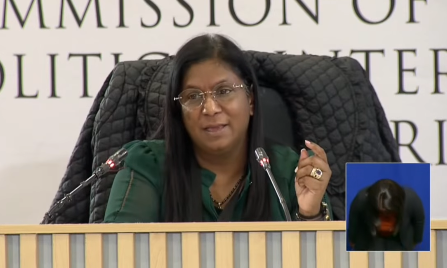
The head of the Investigating Directorate Against Corruption (IDAC), Advocate Andrea Johnson, has defended the directorate’s handling of high-profile investigations into senior Crime Intelligence officers as she continued her testimony before the Madlanga Commission of Inquiry in Pretoria.
Johnson’s long-awaited appearance comes amid mounting scrutiny over allegations that she abused her position, interfered in investigations and acted with a conflict of interest in matters involving senior police officials. Her testimony follows weeks of evidence from several witnesses who accused her of undermining investigations and defeating the ends of justice.
On Wednesday, the commission heard that it was the IDAC itself that approached National Coloured Congress Member of Parliament Fadiel Adams to lodge a complaint against senior Crime Intelligence officers. Johnson confirmed that the directorate engaged Adams and requested that he submit a Section 27 affidavit, a mechanism that allows information to be formally placed before investigators to initiate or support an investigation.
Commission chairperson Acting Deputy Chief Justice Mbuyiseli Madlanga questioned Johnson over the process, challenging her assertion that the affidavit had not been “solicited”. The commission sought clarity on why IDAC had approached a politician to submit the affidavit and whether this raised concerns about the independence of the investigation.
The issue forms part of the commission’s broader inquiry into allegations that criminal investigations targeting senior Crime Intelligence officials were politically motivated and designed to remove individuals from key positions within the South African Police Service.
Johnson also confirmed that she had recused herself from matters involving senior Crime Intelligence officers in June this year after concerns were raised about her continued involvement in the cases.
She told the commission that she requested to be relieved of the investigations on or around 18 June because she believed the persistent allegations against both the investigations and herself had created a conflict that could undermine public confidence in the process.
The cases relate to fraud and corruption charges brought by the IDAC in 2025 against Crime Intelligence head Lieutenant-General Dumisani Khumalo and several senior officers. Prosecutors allege the group colluded to unlawfully appoint an inexperienced individual to a senior Crime Intelligence position, resulting in financial prejudice to the state.
However, several witnesses who have appeared before the commission have challenged the legitimacy of the investigation, claiming the prosecution was driven by political influence rather than evidence of criminal conduct.
Johnson has also faced allegations relating to suspended Crime Intelligence deputy head Major General Feroz Khan. Previous witnesses testified that she allegedly alerted Khan to an assault and intimidation complaint that had been lodged against him, giving him an opportunity to tailor his response before investigators could interview him.
She has repeatedly denied improperly interfering in investigations or acting to protect any individual, maintaining that all decisions taken by the directorate were lawful and based on available evidence.
Her appearance before the commission comes amid reports that she could face suspension following a formal complaint alleging abuse of power and conflicts of interest. The allegations have intensified tensions between the IDAC and certain members of Crime Intelligence, whose relationship has deteriorated significantly over the past year.
During her testimony, Johnson also addressed her personal relationship with suspended Crime Intelligence deputy head Major General Feroz Khan. She acknowledged that the two have known each other for many years and described Khan as a family friend, saying they had attended social gatherings together. However, Johnson denied that the relationship influenced her professional conduct, insisting she had disclosed the association where necessary and rejected allegations that she had acted improperly to protect Khan or interfere in investigations involving him.
Previously, former Major General in the SAPS, Jeremy Vearey told Radio 786 that Khan introduced him to Johnson many years back at a confidentially sensitive meeting of the police that involved detectives and crime intelligence.
The Madlanga Commission was established to investigate allegations of political interference, abuse of intelligence structures and misconduct within Crime Intelligence, including claims that law enforcement agencies were used to pursue factional and political agendas.
Johnson is expected to continue her testimony as the commission further examines the origins of the investigations, the role of the IDAC in initiating criminal proceedings against senior police officials and whether any improper influence was exerted over the investigative process.