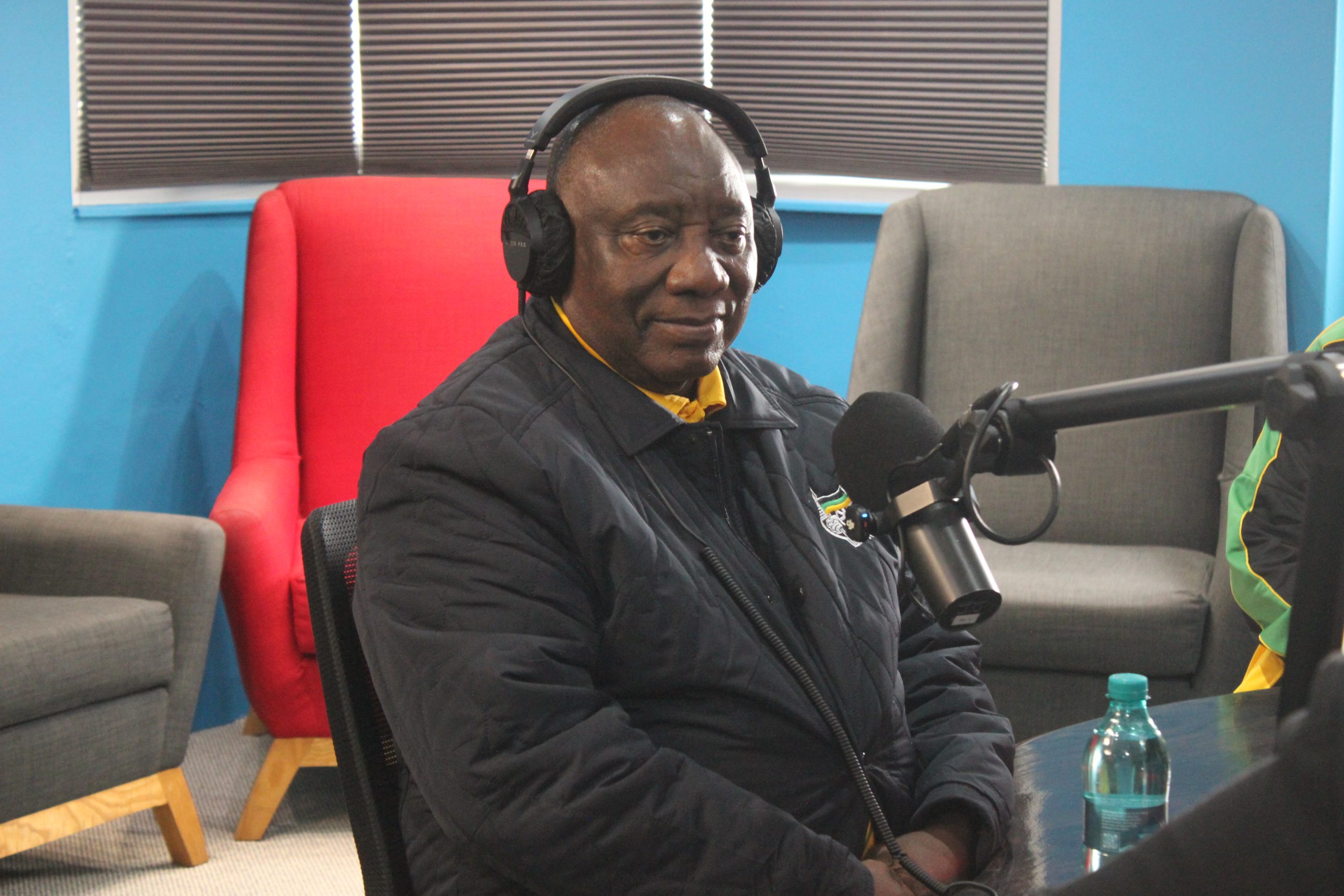
President Cyril Ramaphosa has begun the ANC’s campaign in Cape Town ahead of the November 4 local government elections, using a stop at Radio 786 to address some of the pressing issues facing communities across the city and the country.
Speaking to Radio 786, ANC President Ramaphosa discussed inequality, service delivery, housing, unemployment, crime and policing, spatial planning, governance and the party’s recent legal battle with the Electoral Commission of South Africa (IEC).
The Cape Town campaign forms part of the ANC’s effort to secure an outright majority in the metropolitan municipality, which has been governed by the Democratic Alliance (DA) for two decades.
Ramaphosa said the ANC wants to change the way Cape Town is governed, arguing that the city remains deeply divided along economic and spatial lines.
A “city of two cities”
Describing Cape Town as a “city of two cities”, Ramaphosa contrasted affluent, well-serviced areas with townships where residents continue to experience challenges with housing, water, sanitation and other basic services.
He said the ANC’s campaign would focus on the cost of living, unemployment, service delivery and improving the livelihoods of communities excluded from economic opportunities.
Ramaphosa linked many of Cape Town’s inequalities to the legacy of apartheid spatial planning, which continues to place poorer communities far from economic centres.
He welcomed the Constitutional Court’s ruling on the city’s spatial planning framework, saying it provides an opportunity to rethink how communities are developed. He argued that bringing people closer to employment and economic opportunities could reduce transport costs while improving access to services.
Housing, crime and municipal capacity
On housing, Ramaphosa argued that the challenge is not simply a shortage of funding, but the failure of some municipalities to spend funds already allocated to them.
He said national government provides grants for housing and other services, but municipalities sometimes fail to use these resources, resulting in money being returned to the National Treasury.
Crime and policing were also central to the discussion. Ramaphosa defended the deployment of the South African National Defence Force to support police operations in townships under Operation Prosper, stressing that the army is intended to support rather than replace the police.
He also pointed to the Madanga Commission as an important mechanism for addressing corruption and misconduct within the police service.
Unitary state and governance
Ramaphosa rejected calls for greater devolution of powers, including responsibility for policing and transport, arguing that South Africa should retain its unitary system of government.
He said this approach allows for common norms and standards across the country and enables greater coordination between the different spheres of government.
The President argued that further fragmentation of responsibilities could weaken government’s ability to deliver effectively, pointing to Cape Town’s inequalities as evidence of the need for coordinated planning and governance.
ANC list dispute and the right to vote
Ramaphosa also welcomed the court ruling that allowed the ANC’s full candidate lists to be admitted for the elections.
He described the outcome as a relief for the party and its supporters, arguing that a technical approach by the IEC could have affected citizens’ constitutional right to vote for their preferred political party.
South Africa and Palestine
The interview also covered South Africa’s decision to approach the International Court of Justice over Israel’s conduct in Palestine.
Ramaphosa defended the decision, linking South Africa’s position to its own history of apartheid and its longstanding opposition to injustice and human rights violations.
He said South Africa was pursuing the matter through international law rather than military action.
On questions surrounding diplomatic relations and issues such as coal supplies to Israel or the possible closure of an embassy, Ramaphosa said these matters remained under consideration within government and would be dealt with through the appropriate processes.
The campaign ahead
Ramaphosa acknowledged the challenges facing municipalities, including corruption, limited capacity, inadequate resources and unstable coalition governments. He nevertheless defended the ANC’s candidate selection and vetting processes.
As the November 4 elections approach, Cape Town is expected to remain a key political battleground. Through his Radio 786 engagement, Ramaphosa sought to present the ANC as a vehicle for addressing inequality, improving service delivery and reshaping the city’s spatial and economic landscape.
The interview gave Radio 786 listeners an opportunity to hear directly from the ANC President on issues affecting communities, from housing and policing to municipal governance, spatial inequality and South Africa’s foreign-policy position on Palestine.