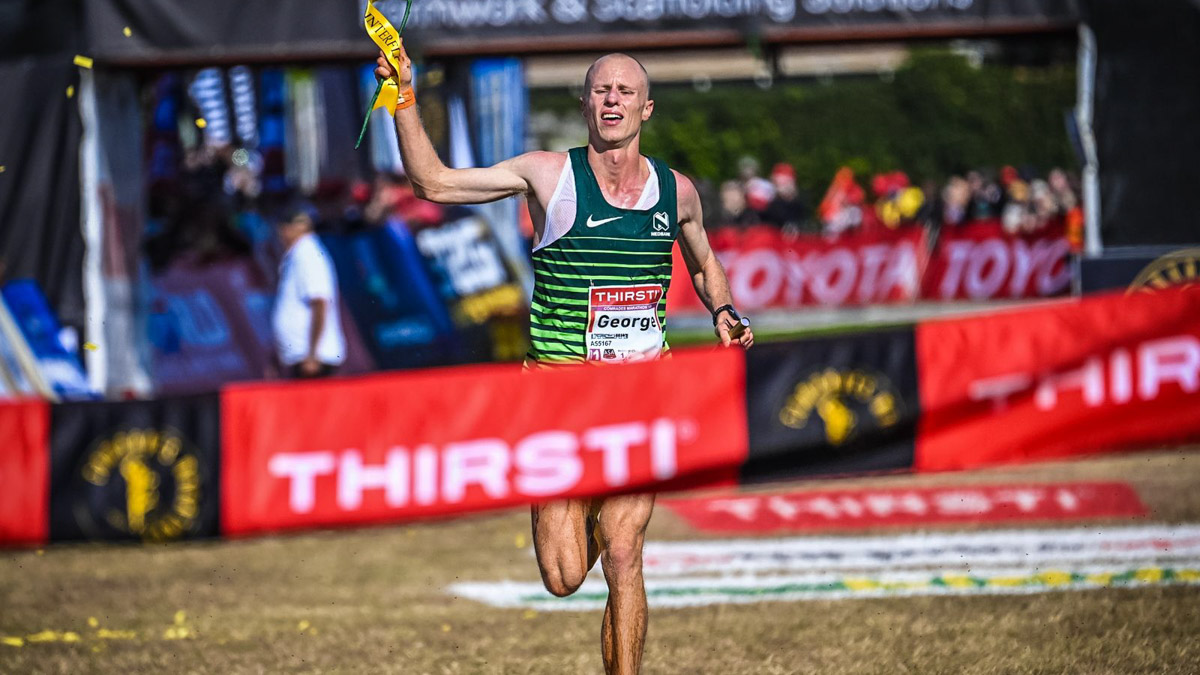
PIETERMARITZBURG, South Africa – The 2025 Comrades Marathon will be remembered as the year history was rewritten on South Africa’s roads, as George Kusche produced one of the greatest performances ever seen in the world’s oldest and largest ultramarathon.
The 27-year-old South African runner stunned spectators and fellow competitors alike when he crossed the finish line in Pietermaritzburg in an astonishing 5 hours, 15 minutes and 56 seconds, smashing the longstanding Comrades Marathon ‘Up’ Run record.
For nearly two decades, Russian athlete Leonid Shvetsov’s time of 5:24:49, set in 2008, stood as one of the most formidable records in ultra-distance running. On Sunday, Kusche not only broke it, he obliterated it by almost nine minutes.
As thousands of exhausted runners continued their journey towards the finish line, Kusche’s remarkable achievement sent waves of excitement through the crowds lining the streets of Pietermaritzburg and across the country.
For many South Africans, his victory represented far more than an athletic accomplishment. It was a moment of national pride, showcasing local talent on one of the sport’s biggest stages.
A Dream Run Through the Valley of a Thousand Hills
The Comrades Marathon is often described as a race against the body, the mind, and the unforgiving terrain between Durban and Pietermaritzburg.
This year’s “Up Run” covered approximately 89 kilometres of punishing climbs, steep gradients, and relentless ascents. Runners battled fatigue, dehydration, cramping muscles and mental exhaustion as they made their way through KwaZulu-Natal’s iconic Valley of a Thousand Hills.
Yet Kusche appeared almost untouchable.
Maintaining an extraordinary pace throughout the race, he ran with confidence and composure, gradually pulling away from a highly competitive field.
His average pace was so exceptional that he also shattered another long-standing record – the fastest average pace in Comrades history. His average of faster than 3 minutes and 43 seconds per kilometre eclipsed the benchmark set by Belarusian legend Vladimir Kotov in 2000.
The feat highlights not only Kusche’s endurance but also the evolution of elite ultra-marathon running, where athletes continue to push the boundaries of what many believed was physically possible.
Rewarding Excellence
The record-breaking performance came with a substantial financial reward.
Kusche walked away with the winner’s prize of R925 000, while earning an additional R605 000 for breaking the Up Run record.
His record average pace secured yet another bonus of R550 000, bringing his total earnings for the day to more than R2 million.
But for many observers, the greatest reward was the place he has now secured in Comrades Marathon history.
His name will forever be mentioned alongside some of the race’s greatest champions.
The Human Story Behind the Numbers
Behind every elite athlete lies years of sacrifice, discipline, and resilience.
While spectators celebrate the record-breaking finish, few see the countless early mornings, gruelling training sessions, injuries, missed family occasions, and personal sacrifices that accompany the pursuit of excellence.
For Kusche, Sunday’s victory was the culmination of years of dedication to a sport that demands almost superhuman commitment.
Friends, family members, coaches and supporters who have followed his journey witnessed the emotional payoff of years spent chasing a dream that many thought impossible.
His achievement also serves as inspiration for thousands of ordinary runners who lined up at the start in Durban.
Many participants were not racing for prize money or records. They were running in memory of loved ones, raising funds for charity, overcoming personal challenges, or attempting to earn their first coveted Comrades medal.
As Kusche celebrated victory at the front of the field, thousands of runners behind him were engaged in their own deeply personal battles – proving once again why Comrades remains much more than a race.
International Competition Pushes the Pace
Defending Up Run champion Piet Wiersma of the Netherlands delivered another impressive performance, crossing the finish line in 5:19:36 to claim second place.
Under ordinary circumstances, Wiersma’s time would have been considered exceptional. Instead, he found himself part of a historic race dominated by Kusche’s record-breaking pace.
The strong international field once again demonstrated the global appeal of the Comrades Marathon, which attracts elite athletes and amateur runners from across the world.
Yet this year belonged to a South African.
More Than a Marathon
Since its inception in 1921, the Comrades Marathon has become one of South Africa’s most treasured sporting events.
Named in honour of soldiers who fought during World War I, the race has evolved into a symbol of endurance, unity, perseverance and human spirit.
Every year, the event brings together people from different backgrounds, cultures and countries, all sharing the same road and the same goal: reaching the finish line.
This year’s race delivered everything that has made Comrades legendary – heartbreak, triumph, determination and history.
And at the centre of it all stood George Kusche, a young South African runner whose extraordinary performance has etched his name into the record books and inspired a new generation of athletes.
As celebrations continue and the dust settles on another unforgettable edition of the Ultimate Human Race, one thing is certain: the hills between Durban and Pietermaritzburg have never been conquered faster.